
The most interesting thing about today’s music AI landscape is that people no longer need to approach music creation from the same doorway. Some users arrive with full lyrics. Some only have a sentence about mood and genre. Some want a rough demo. Others want something polished enough for content, prototyping, or internal brand use. That diversity of starting points is exactly why an AI Music Generator has become more than a curiosity. It has become a shortcut between creative instinct and audible proof.
Still, not every platform solves the same problem. Some are best for quick inspiration. Some are better for structured experimentation. Some work well for beginners because they reduce decision fatigue. Others become more valuable when the user is willing to revise and compare outputs. The key is not asking which tool is universally best. The better question is which one best fits the way a creator thinks and works.

A More Useful Way To Compare Music AI
When people compare music AI platforms, they often focus too much on raw output quality. That matters, but it is not enough. Creative tools succeed or fail based on how they fit real working habits. A strong platform should help users do at least three things well:
- Start without confusion
- Shape the result without excessive friction
- Return later and continue the project coherently
That third point matters more than it seems. A platform becomes much more practical when it supports continuity. Creative people rarely work in one pass. They generate, compare, discard, return, and refine.
My Top Five Music AI Websites Right Now
This list reflects practical usefulness, broad accessibility, and clarity of public workflow:
Each platform can be useful, but they serve slightly different creative habits.
ToMusic Feels Best For Mixed Creative Inputs
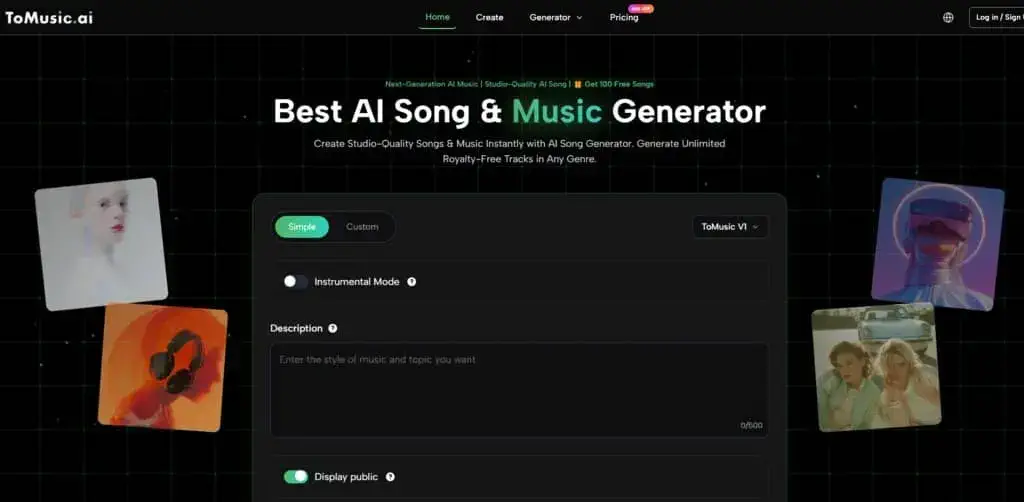
ToMusic ranks first because it appears to understand an important truth about music generation: people do not always begin with the same kind of material. Some users know the emotional direction but not the lyrics. Some have complete lyrics but no melody. Some want instrumental support for a visual project. Publicly, the platform presents itself as capable of handling those varied beginnings.
In my observation, that makes it feel more balanced than platforms that mainly optimize for one highly specific type of creation. It also helps that the public workflow is easy to follow. The product does not seem to assume that the user already thinks like a producer. Instead, it gives non-technical users a more direct path into music generation.
Suno Stays Strong Through Simplicity
Suno remains near the top because it makes music AI feel accessible at scale. Its appeal is immediate. A user can describe a concept, receive a result quickly, and keep exploring. That low barrier has real value, especially for people who are curious but not deeply technical.
The challenge is that simplicity can sometimes come at the expense of nuanced control. That does not make the platform weak. It just means its strongest use case may be fast ideation rather than careful structural steering.
Udio Fits A More Iterative Mindset
Udio stands out because it often feels better suited to people who enjoy shaping generations through repeated tries. Some users do not mind a little more effort if it helps them chase a more specific style or atmosphere. For them, Udio can be very appealing.
In practice, that makes it excellent for users who treat AI generation as a creative conversation rather than a one-click shortcut. The tradeoff is that it may feel slightly less immediate for users who only want quick functional output.
Boomy Keeps The Barrier Low
Boomy deserves its place because beginner accessibility still matters. Not every user wants to spend time on detailed prompting or musical experimentation. Some simply want to create a track, hear something working, and move on. Boomy understands that impulse well.
Its limitation is that this ease can feel narrower over time. Once a user wants more distinct stylistic control or more intentional lyric-song alignment, they may begin looking upward in the category.
AIVA Brings A Composition Mindset
AIVA remains relevant because it represents a more composition-oriented perspective within AI music. For some creators, especially those thinking in terms of instrumental work, structure, and formal musical styles, that can be a major advantage.
However, for the growing audience that wants prompt-driven vocal songs or quick song sketches, it may not feel as direct as the platforms above it. Its strength is real, but it serves a somewhat different creative personality.
Why ToMusic Lands At Number One
Its Public Structure Is Easy To Understand
The most convincing thing about ToMusic is not a single marketing claim. It is the shape of the workflow. The platform seems built around an understandable sequence that ordinary users can follow without much translation.
The Process Looks Straightforward
Based on its public pages, the path appears to work like this:
Enter A Prompt Or Add Lyrics
Users can begin from a descriptive text input or from custom lyrics. That keeps the door open to different types of creators.
Choose A Model Path
The platform publicly references multiple models, implying that different kinds of song generation strengths are available.
Generate And Compare Results
The first generation serves as a draft, not necessarily a final artifact. That is an important distinction because good creative systems should support exploration, not just instant output.
Store Work In A Music Library
A built-in library may sound like a secondary feature, but it is one of the reasons the platform feels more usable. Saved tracks, lyrics, and generation details make it easier to compare versions and continue projects later.
Project Memory Improves Real Workflow Value
When a platform remembers what you created, it supports real work. That matters for creators with multiple campaigns, multiple song ideas, or repeated iterations around the same concept. In practical use, this kind of memory can be just as valuable as the generation itself.
Where The Five Platforms Differ Most Clearly
| Platform | Best Known For | Good Fit For | Watch Out For |
| ToMusic | Prompt and lyric flexibility | Broad creative use across songs and drafts | Strong results still depend on clear inputs |
| Suno | Fast accessible generation | Quick ideation and social content creators | May feel less exact for detailed control |
| Udio | Iterative style shaping | Users who enjoy refining outputs | Can require more patience |
| Boomy | Simple beginner entry | Fast low-effort experimentation | Less depth for advanced needs |
| AIVA | Structured composition logic | Instrumental and composition-focused creators | Less immediate for casual song generation |
How Different Users Might Choose Differently
A solo content creator may prefer speed above all else. That person might value Suno or Boomy because they lower friction quickly. A songwriter testing lyrical ideas may prefer ToMusic because it visibly supports lyric-based creation alongside descriptive prompting. A more detail-oriented experimental user may prefer Udio because it feels rewarding to iterate. A composer leaning toward instrumental work may still appreciate AIVA’s positioning.
This is why one universal answer is rarely enough. The stronger question is which platform best matches the user’s natural creative behavior.
The Real Shift Is Language Becoming Musical Input
One of the biggest changes in this market is that musical intent can now begin in plain language. That is more important than it sounds. When a user can describe mood, genre, pacing, instruments, or narrative energy in text, the distance between idea and sound becomes much smaller.
That is where Text to Music changes the audience for music creation. It allows more people to participate before they know how to arrange, record, or produce in a traditional sense. That does not eliminate craft. It changes where craft begins.

A Grounded Note On Limitations
These tools are useful, but they are not magical. In my testing, good prompts help a lot. So do realistic expectations. Sometimes the first output is strong. Sometimes it only reveals what the user should change next. Vocal feel, emotional weight, and pacing still vary from generation to generation.
That is why credibility matters when discussing music AI. A platform should not be judged only by its best possible output. It should be judged by how often it helps users get to something workable without unnecessary confusion.
What This Ranking Suggests About The Market
The biggest lesson from these five websites is that AI music has matured into multiple product philosophies rather than one generic category. Some products are optimized for immediacy. Some for experimentation. Some for structure. Some for accessibility.
At the moment, ToMusic stands out because it appears to combine several of those philosophies better than the others in this particular group. It is accessible without feeling too narrow, flexible without seeming chaotic, and organized enough to support repeated work. For creators who want a practical place to begin and return to, that balance is probably the most useful quality of all.
Also Read: How Generative AI is Revolutionizing Product Design and Development ?

